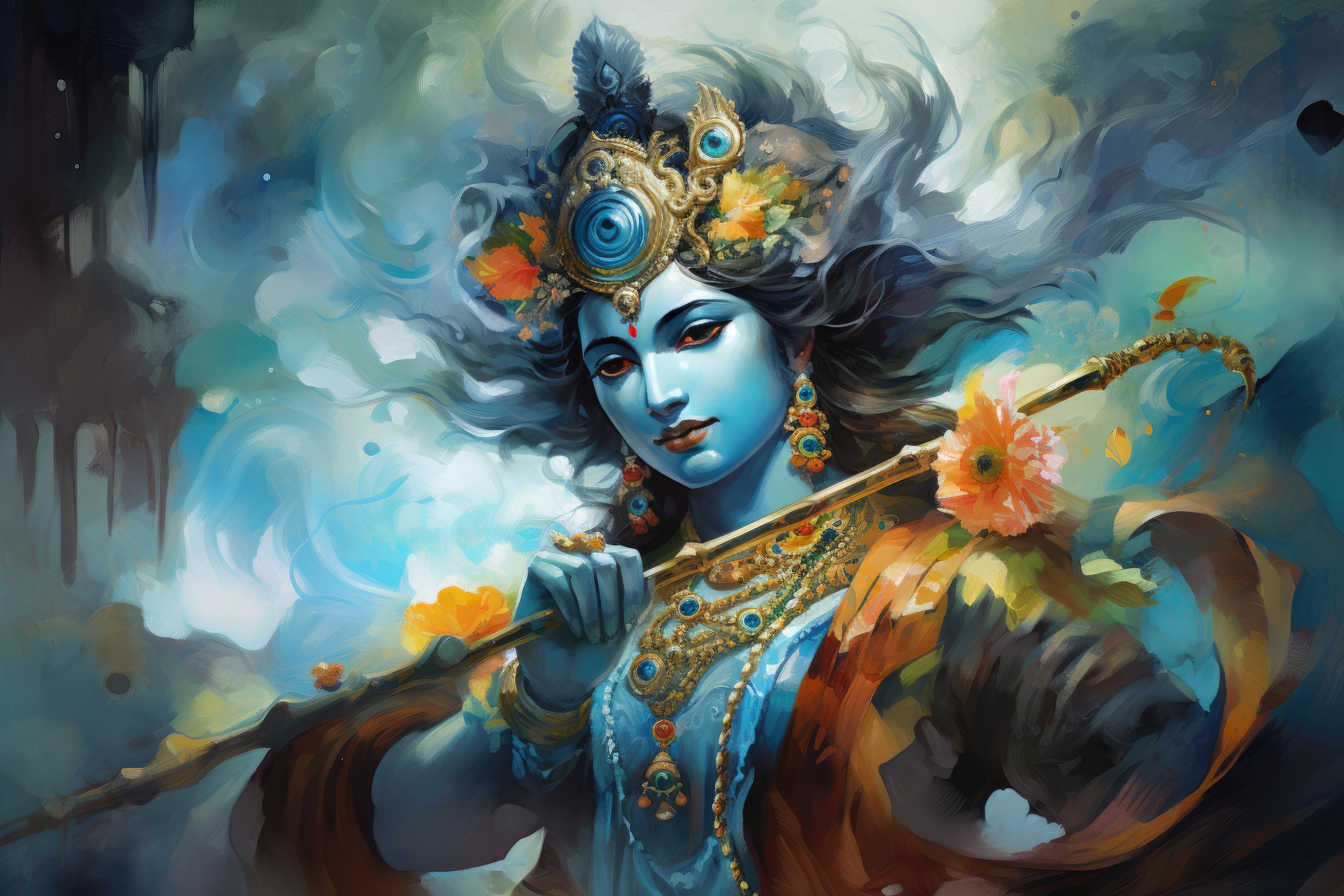
Narsinh Mehta - The Adi-Kavi of Gujarat
Narsinh Mehta is undoubtedly the most loved poet of Gujarat. He was a family man and a great devotee of Lord Krishna. He was a poet-saint and was born in Junagarh, Gujarat in 1415. Born in a reputed Nagar-Brahman family, his elder brother Vanshidhar Mehta was the Kotwal of Junagarh city and people respected their family.
Born in Junagarh, Gujarat to Krishna Damodar and Laxmigauri, both great devotees and highly religious. His parents passed away when he was just five years old.
At age eight, he started speaking by the grace of a Sadhu. It is believed that Lord Krishna blessed Narsi Mehta in the form of that Sadhu. While departing, the Sadhu asked Narsi Mehta to recite "Radha-Krishna" as the mantra.
His grandmother Jayakunwari took care of him and ensured that he had a pious life. Narsi Mehta was married to Manikgauri and spent his time in cutting the grass for the horse and reciting the Radha-Krishna mantra. They were blessed with a daughter and a son. His daughter was named Kunwaribai and son was named Shamaldas.
His sister-in-law who wasn't happy that Narsi Mehta was not contributing to the household expenses one day, threw them out of the house and Narsi Mehta took shelter in a Shiva temple. He did severe Tapa (penance) for seven days. Lord Shiva was pleased with his penance, appeared before him and then took him to Dwarka for giving him a divine glimpse of Lord Krishna.
Narsi Mehta has described this divine place very vividly. He said that the land was of gold, the palace pillars were made of jewels and every particle was charged with divinity. Lord Shri Krishna welcomed him and he started living there with the Lord. It was the day of Sharad-Poornima (full moon night in the beginning of the winter season) Lord put his Pitambar on Narsi and started playing 'Raslila' (the divine dance) with the Gopis.
Narsi Mehta was holding a torchlight. He was so engrossed in the Raslila that he did not notice that the torch-light was burning his hand. It was only after the completion of the Raslila that everyone and the Lord noticed it. Pleased with his devotion the Lord embraced him and Rukmini gave her necklace to him. After staying there for a month, Narsi returned as a Vaishnava, to discharge his responsibilities and to spread Lord's bhakti. He brought back a Lord Krishna idol, a peacock feather and Pitambar, as souvenirs.
His poem, Putra No Vivah (Son's Marriage) deals with the incident of his son's marriage and depicts how the poet, like Sudama, went to Dwarka to seek Lord's assistance and how Sri Krishna himself attended the marriage procession.
Another poem, Mameru depicts the incident in which the penniless father prayed to Lord Krishna, as he had no money to do 'Mameru' - the custom of giving gifts to the girl's in-laws by her parents in the seventh month of her first pregnancy. Krishna of course turns up and saves his devotee's honor.
Who helps those in distress without any pride or ego"
It was said that the Lord was always at the call of Narsi Mehta. Whenever he remembered Him, He appeared before him. Narsi Mehta was overwhelmed at the kindness and grace of the Lord.
He is called as 'adi kavi' or the First Poet of Gujarat, not because he was the first poet who composed in Gujarati, but because he was the first major poet popularity of whose compositions has stood the test of time. His beautiful songs dealing with the love of Radha and Sri Krishna are models and a constant source of inspiration for all.
One of the most important features of Narsinh's works is that they are not available in the language in which Narsinh had composed them. In his later life, Narsinh sang about renunciation, significance of Bhakti and ethics.
He announced that for human beings bhakti is the greatest objective to achieve as bhakti is not possible even for gods. Those, who reach the heavens due to their Punyas (good-deeds), have also to fall back after they have exhausted their quota. On the other hand the devotees ask for birth as human beings again and again in order that they could do bhakti. He said the parents of those people are fortunate, who devote themselves to bhakti. Those, who are not devotees, their mothers bear their burden unnecessarily.
Narsi Mehta is most famous across the country for his poem "Vaishnava Jana Te" which was adopted as a prayer by Gandhiji at his ashram. Narsi Mehta led people from darkness to the light of bhakti.